
Turn Storytime Into The Skill That Ends Meltdowns.
A complete story set that helps toddlers build the self-regulation skills timeouts were never able to teach.
So the next "time to go" doesn't end on the floor, kicking and screaming...
They start catching the big feeling and naming it, the way calm actually begins.

"They'll Grow Out Of It" Is Not A Plan.
Everyone tells you it's just a phase.
So you wait. But the years when a toddler's brain is wiring how it handles frustration, disappointment, and anger don't wait with you.
The foundations for self-control are built early, and the kids who get to practice it young don't just melt down less. They carry the skill for life.
Every meltdown that gets punished or waited out is a missed chance to teach the one skill underneath it: catching a big feeling before it takes over.
That's not patience. That's time you don't get back.
Turn everyday storytime into the moment your toddler learns to handle big feelings.


Emotions and Powers - 4 Book Box Set
Emotions and Powers - 4 Book Box Set
- Finally get through a "no" without it ending on the floor.
- Built the way kids actually learn to handle big feelings.
- Grounded in how self-regulation is really taught: name it, then tame it.
- Give them a calm-down skill that lasts a lifetime.
Couldn't load pickup availability
- American express payment method
- Apple pay payment method
- Diners club payment method
- Discover payment method
- Google pay payment method
- Master payment method
- Paypal payment method
- Shopify pay payment method
- Visa payment method
You Asked, We Restocked (Again). Limited Supply.
Back Guarantee
1-2 Days
Checkout
Whats Included?
Whats Included?
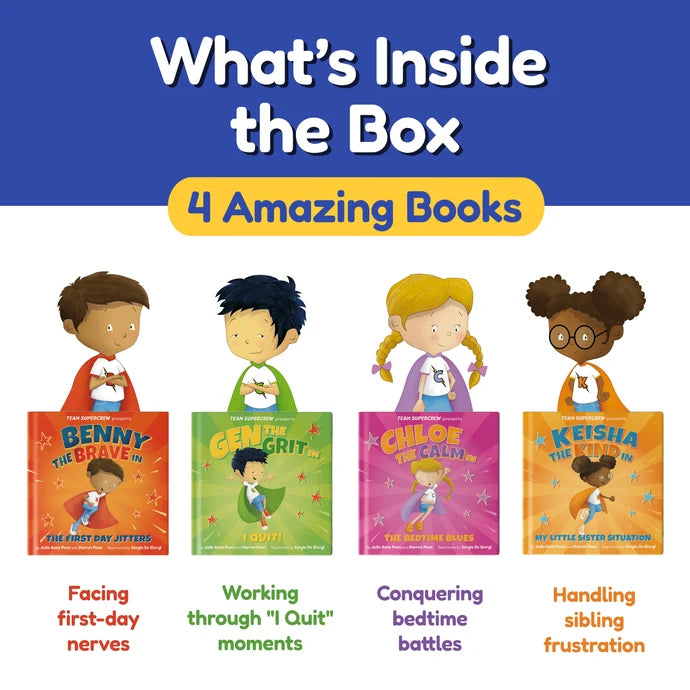
The Emotions and Powers Bundle includes all four BraveNest books, one for each big feeling that sends a toddler over the edge. Written for children ages 2 to 6, these warm, colorful stories make it easy to help your child learn to handle anger, worry, frustration, and overwhelm. No special training required.
Kids don't learn to calm down by being told to. They learn by watching a feeling get handled. Each book follows that natural process: a hero feels the exact same big feeling your child does, names it, and finds the way through, so your child copies the skill instead of getting lectured for having the feeling.
📗 The Brave Book
Face the Scary Stuff
For the fears that come out as tears, freezing, or a flat "no." The hero shows your child the brave was inside them the whole time, so the doctor visit, the dark, and the first drop-off stop ending in a meltdown.
- Helps kids face fear instead of melting down over it
- Turns "I can't" and "I won't" into "I can try"
- Gentle prompts you can model at home
🧡 The Kind Book
Handle the Anger Without Lashing Out
For the sibling blowups, the grabbing, hitting, and "mine." The hero shows your child how to feel the anger and still choose kind, so the fights stop turning into fists.
- Teaches what to do with anger instead of acting on it
- Made for sibling conflict and playground grabbing
- Builds empathy through the hero, not a lecture
💙 The Calm Book
Cool the Volcano Before It Blows
For the giant meltdown over a wrong cup or a "time to go." The hero shows your child how to spot the volcano feeling rising and bring it down before it hits the floor.
- Names the big feeling so your child can catch it early
- A simple calm-down move kids can actually use in the moment
- Turns transitions and small triggers into fewer blowups
⭐ The Grit Book
Try One More Time
For the "I can't" that ends with the toy thrown across the room. The hero shows your child how to breathe through the frustration and try again instead of giving up.
- Builds frustration tolerance and stick-with-it
- Perfect for the kid who rage-quits puzzles, shoes, and games
- Encourages a second try without the power struggle
🌟 Why Parents Love This Bundle
- Four big feelings, one story each, so nothing gets skipped
- Play-driven and simple to read, zero training needed
- Grounded in how kids actually learn to self-regulate: name it, then tame it
- Durable design built to survive nightly re-reads
Includes: The Brave Book, The Kind Book, The Calm Book, The Grit Book (4 books)
Perfect for: toddlers with big meltdowns, sibling battles, bedtime blowups, or any parent tired of timeouts that don't stick 🎁
👶 Ages 2–6 📚 4-Book Set ❤️ Feelings-First 🚚 Free Shipping on Bundles


Real bedtimes, real calm.
You've tried everything they told you to.
You stay calm and get down to their level.
You count to three. You take the tablet away.
You put them on the step and wait it out.
And still, the next little thing sets them off.
Because none of it teaches the skill underneath the meltdown.
"Everyone kept telling me it's just a phase. I couldn't just sit there."
"I felt so helpless. I needed something I could actually do."
Kids don't calm down because you tell them to. They learn it in a sequence.
First they have to spot the big feeling. Then name it. Then see it handled. Then practice it while they're calm, so it's there when the storm hits. Timeouts skip straight to "behave" and leave out every step that gets them there. A story walks the whole path, the same way regulation is actually taught, name it to tame it, so you're finally doing something that matches how a child learns to settle themselves.
Ten minutes at bedtime. That's the whole ask.
No behavior charts. No power struggles. Just you, your child, and the one thing that actually teaches them to handle big feelings.
Why this does what timeouts and sticker charts can't.
punishment
charts
From parents who stopped waiting.
Everyone kept telling me she'd grow out of it. I couldn't just wait and hope. This finally gave me something to do at bedtime instead of dreading the next meltdown.
I figured it was just another feelings book. But the Calm one clicked. Now she says "I'm having a big feeling" instead of hitting. Did not expect that.
We're on a waitlist until spring. This is what we do while we wait, and for the first time I don't feel completely helpless watching him lose it.
We had a whole shelf of feelings books that did nothing. The difference here is the hero does the feeling, so she isn't being lectured. That's what made it land.
I was so tired of being the mom apologizing at every party. He's not perfect, but he catches himself now more than he doesn't. That changed things for both of us.
My son is as strong-willed as they come and I was sure nothing would touch him. Two weeks in he told me the volcano was getting big and walked away. Floored.
Questions, answered honestly
Straight answer: this is a set of books, not a treatment, and it doesn't replace a pediatrician or a child therapist. What it does is give you a calm, repeatable way to teach the skill underneath the meltdown, built on how kids actually learn to handle big feelings, so you're doing something instead of just riding out the next storm. If the meltdowns feel beyond the everyday, please loop in a professional too.
Written for ages 2 to 6, the stretch where big feelings show up faster than the words to handle them. Younger toddlers enjoy the read too, and older kids still pick up the language, since the skill is what matters, not the birthday.
Most feelings books just name the emotion and stop. These show a hero moving all the way through it, spotting the big feeling, naming it, and finding the way down. Your child watches the skill get done instead of getting a lecture, which is why it sticks.
About ten minutes a night. It slots into the bedtime routine you already have, so the calm gets rehearsed when things are quiet, not in the middle of a meltdown.
Then you pay nothing. Read it together for 30 days. If you don't feel more in control and more hopeful, email us for a full refund and keep the books. No hoops.